Landscape StoriesJanuary 23, 2026– 7 min read
Chasing G4s - Northern Lights in the Burren
A story posted in the Burren Stories, a section of the The Burren Light & Landphotography project. New to the Burren? Start here.
As we are going through a period of busy sun activity called 'solar maxima' we have been able to witness one G5 and four G4 in the last couple of years in Ireland. It's all very exciting!
When particles are ejected from the Sun (during solar flares or coronal mass ejections), they can (not always) travel toward Earth carried by the solar wind. These charged particles are guided by Earth’s magnetic field toward the polar regions. The stronger the particle flux, the stronger the auroral storm, and the farther from the poles the aurora can be seen.
Because of Earth’s curvature and the structure of the aurora, during weak auroral storms in Ireland we usually only see the highest-altitude emissions. These are typically red and orange, produced by oxygen at very high altitudes (200–400 km). The green aurora occurs much lower (around 100–150 km), so it often remains below our horizon.
During severe (G4) or extreme (G5) storms, the auroral oval expands southward and downward. The lower-altitude emissions move overhead, allowing us to see green aurora as well. This is why in Ireland we sometimes see only red or orange glows, and other times — during intense storms — we see vivid green curtains.
In the Burren, we need at least a G3 (strong) storm to have a chance to see an aurora. Strong storms occasionally bring additional phenomenons, the stronger the storm is the better chance to see with a naked eye. I found that a G3 storm is quite hard to see with my own eyes even in darkness when all conditions are met as, to the unreliability of Irish weather, add a fair dose of space weather complexity and the possibility for a fuller moon to wash out any aurora in the sky. A lot of things have to fall into place to see an aurora so low in latitude from the pole.
The call that got me going
Before getting in to that call, I have to give credit to the 'Irish Aurora Chasers' Facebook group as it's the only 'knowledgeable' group where I could find decent advice, friendly contacts and a ton of information. Along with a few apps I use (one being the 'Glendale' app) this is by far the best group out there for aurora chasers in Ireland. Thanks to the group mods we're getting storm watches and good advice on when and where we have the best chance to see it ahead of time: weather, moon coverage and storm intensity are crucial parameters. Well... Ahead of time, most of the time...
The particles, ejected by the solar flare responsible for the aurora on the night of the 19th, were carried by extremely fast solar winds which delivered them through the earth atmosphere in one day, in stark contrast with the 2 to 3 days it would normally take! This storm took everyone by surprise
Everyone, except my friend Fergus who had seen a social media post and had the great idea to let me know about this around 8pm.
Severe storm intensity reached!
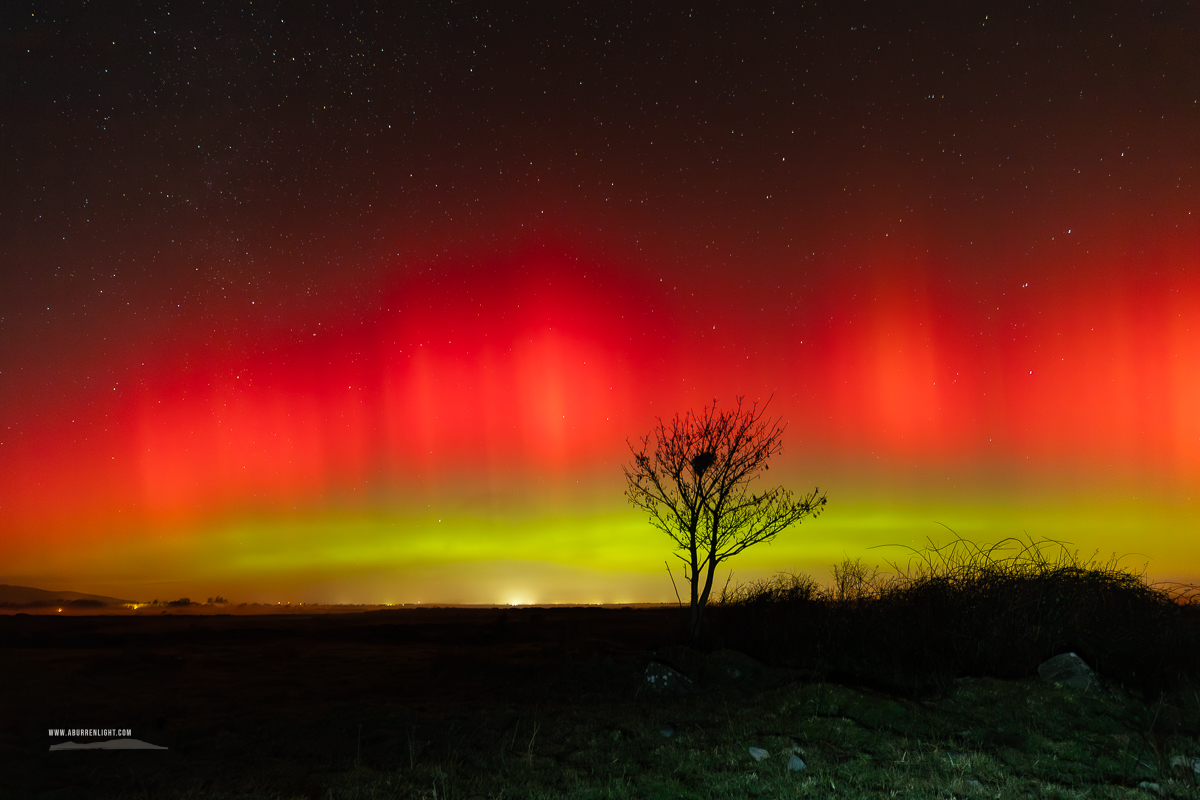
Not thinking too much I head out to one of my safe zones for an easy foreground to shoot at night: a lone tree. The aurora was clearly visible up in the sky and as it went on, it became quite spectacular and probably the best display of red pillars I was given to see so far. I feared the mist would be an issue but on the contrary, it added to the ambiance and gave an extra soft glow to the aurora. I use a camping lamp with a torch and an ambient dimmer ring light which works a treat to lit up the foreground, which is the best way to get a nice foreground with little noise. To avoid 'light burns' I sweep the light left and right giving some dimension to the image by giving additional focus on one area or another.
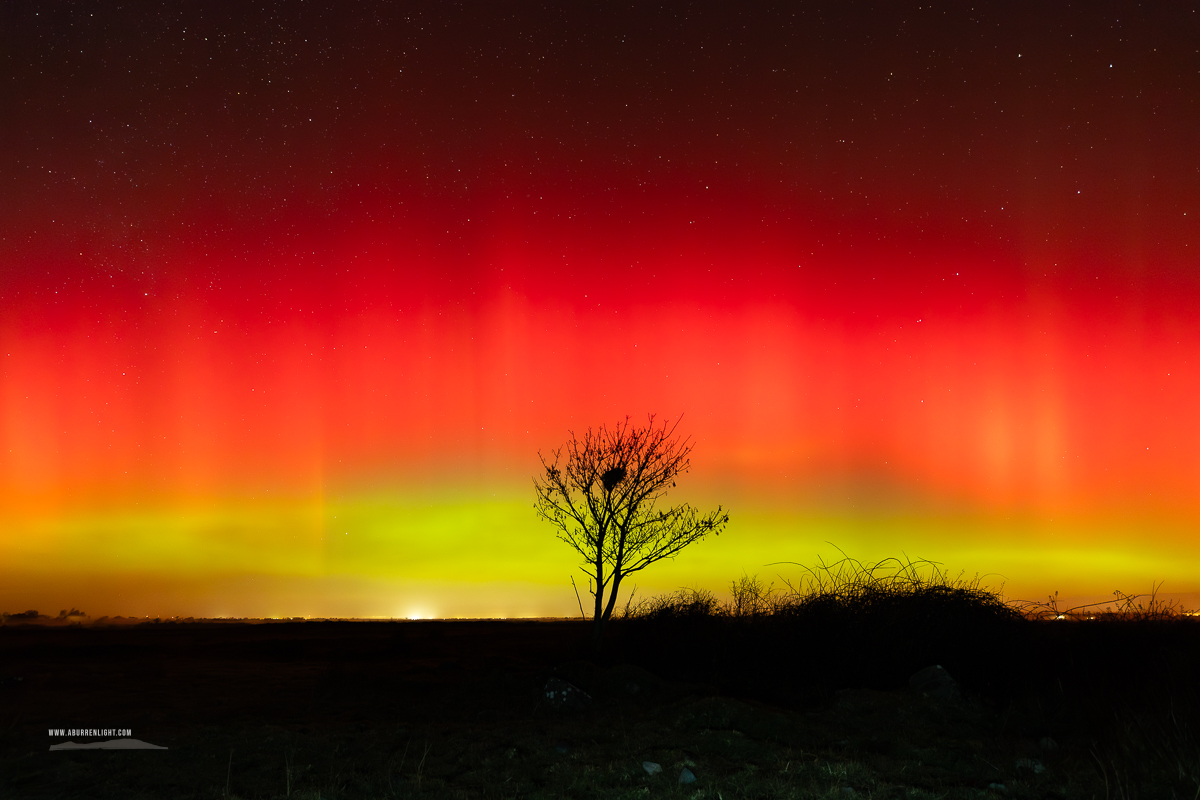
The mist cleared up a little more and, in front of me, the aurora display intensified to reach its peak that evening. What a beautiful sight! At this stage I could clearly see the beams dance in front of my eyes. It's always a trade off between shooting and watching!
As the red slowly subsided, I decided to make a move for another location, on the 'new road', on the way to Boston. A phenomenon caught my eyes toward the south west and I did not want to miss it for anything: the rarer green northern lights, which I caught in the previous G4 storm, were dancing in the sky.
You can already see those in the background and as the storm gained intensity it spread over our heads, it was time to move.
Less impressive but just as spectacular
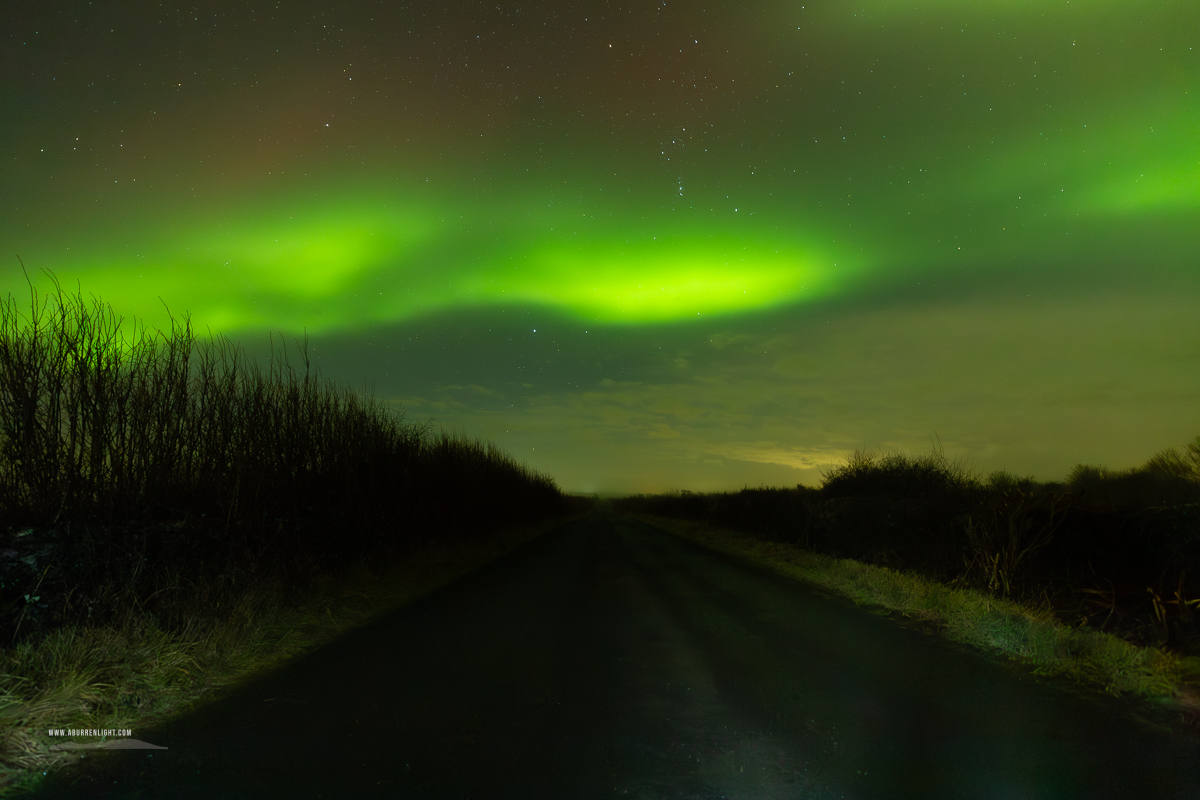
As mentioned at the beginning of this story, the green lights only show up with bigger storms as they are upon and above us in the sky. These give the most amazing display, dancing above our heads, with a hint of purple and red in higher altitude. I set the tripod in the middle of the road and actually made a short movie to remind myself of their activity.
Photography in the darkness of a new moon is not easy. My first aurora was mesmerizing to see (there were also a SAR and a STEVE! Two rare phenomenons associated with aurora), but my photos were extremely noisy as I did not use any light to lit up the foreground. In fact much of those photos were unusable! Whether you use a camera or a phone, do remember to bring in some form of light. Thanks to this light you can use a relatively lower ISO of 2500, focus the camera on the foreground, and reduce the exposure time to about 4 seconds. I would usually leave the light on, sweeping left and right (or not) for about 2 seconds then turn it off. With such practice, the foreground is well in focus and subtly lit up to give your image the depth it needs, in focus. If you've ventured quite deep into the Burren, this torch will also be a lifesaver as it will show you a way back. You would be surprised how disorientating darkness actually is!
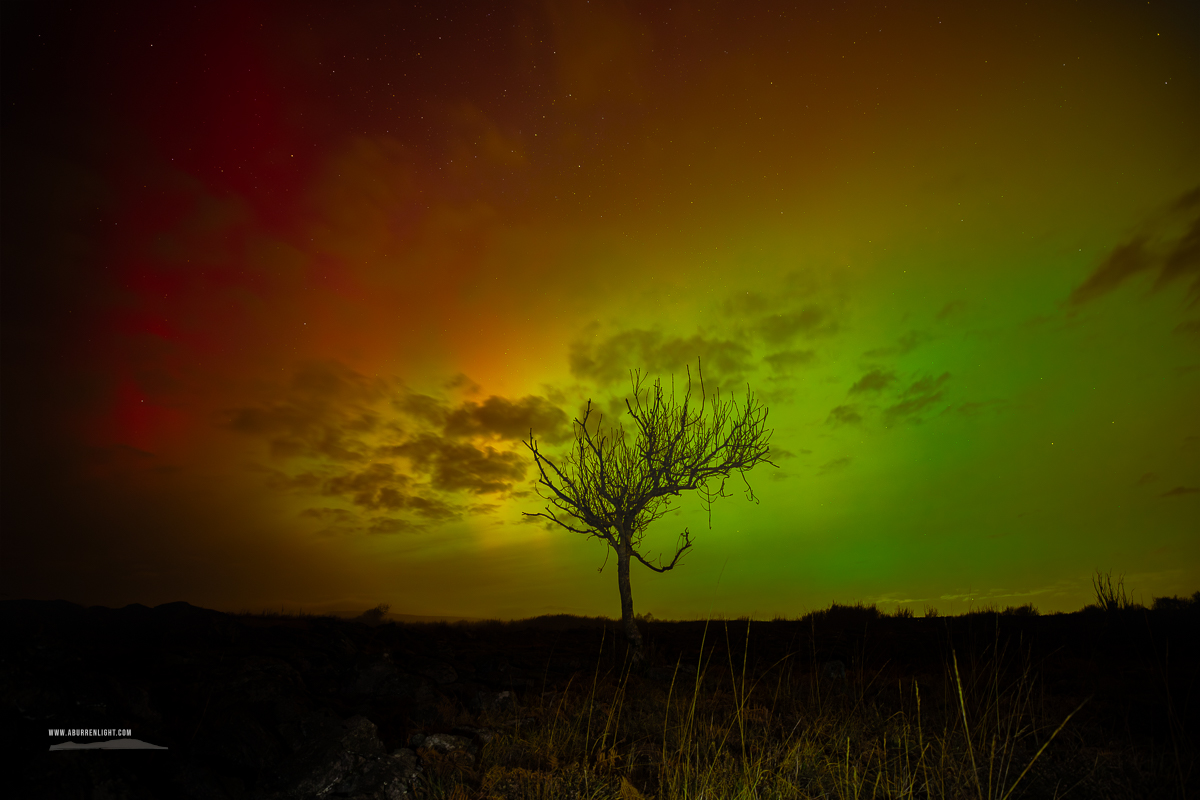
From the road I made my way to another favourite gem of a lone tree which I photograph many times. It was very slippery, something you must also be very wary of as if you break an ankle and you left the house alone, you're pretty much alone in the Burren! No one is going to come and get you which, oddly enough though in different circumstances, is really one of the things I love about living here!
A huge green cloud had formed over the west, I couldn't really see the colour with my own eyes (by then the space weather was no longer playing ball) but it was showing clearly on camera, I kept shooting. This, was the end of my night. I missed the aurora on the following day, but I think I did ever so well. And, I was back in time for some Netflix :)
Discover the photography collection! Portfolio and Limited Editions fine art prints selling & shipping worldwide.
Following on related topics, some visual pages to bring you deeper into the Burren Light & Land project: